No content results match your keyword.
Content

You have successfully logged out.


Not registered yet?
Absorbable Sutures
An ultra long‑term absorbable monofilament suture designed to support prolonged healing, meeting EHS and BHS guidelines.1, 2

Monomax®
Monomax® is B. Braun's ultra long-term absorbable monofilament suture, developed specifically for fascial and abdominal wall closure. Combining high elasticity and prolonged wound support; when combined with small bite closure, Monomax® provides exceptionally prolonged wound support throughout the critical healing period, retaining approximately 50% of its initial tensile strength at 12 weeks in vivo, when conventional PDS II has no residual tensile strength.3
These characteristics make Monomax® particularly well suited to midline laparotomy and abdominal wall closure.
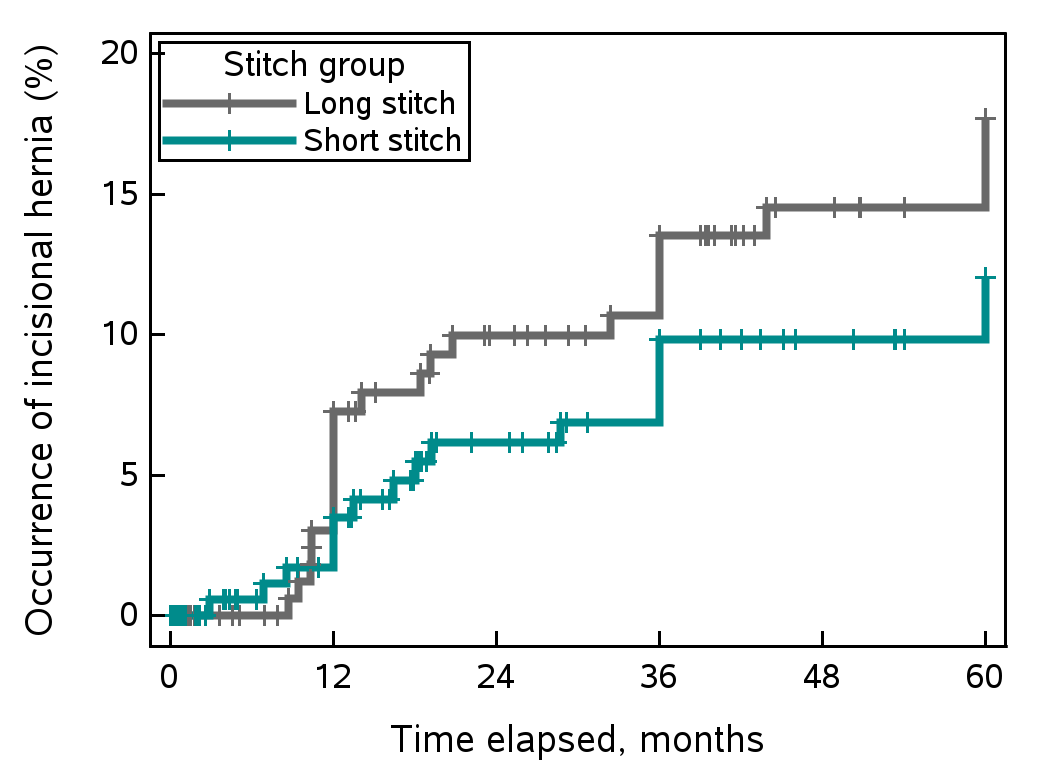 Fig. 2 from: 5-year clinical outcome of the ESTOIH trial comparing the short-bite versus large-bite technique for elective midline abdominal closure (6): Incidence of IH until 5 years postop.
Backed by Long-Term Clinical Evidence.
The ESTOIH trial is the first randomised controlled study to report 5-year outcomes comparing short-bite (also known as small bite or short stitch) and large-bite closure techniques using Monomax®.
The small bite technique demonstrated lower incisional hernia rates at every follow-up timepoint, supporting its role as an evidence-based approach to abdominal wall closure.7, 8

“Using the short-bite [small bite] technique in combination with an extra-long-term absorbable, elastic, monofilament poly-4-hydroxybutyrate suture (Monomax®), it may be possible to achieve a very low incisional hernia rate in the long-term follow-up.”
Technique Matters
For elective midline abdominal closure.7,8
B. Braun supports surgeons and surgical teams through dedicated abdominal wall closure education and practical skills training.
Workshops can include:
1. David L Sanders, Maciej M Pawlak, Maarten P Simons, Theo Aufenacker, Andrea Balla, Cigdem Berger, Frederik Berrevoet, Andrew C de Beaux, Barbora East, Nadia A Henriksen, Miloslav Klugar, Alena Langaufová, Marc Miserez, Salvador Morales-Conde, Agneta Montgomery, Patrik K Pettersson, Wolfgang Reinpold, Yohann Renard, Simona Slezáková, Thomas Whitehead-Clarke, Cesare Stabilini, Midline incisional hernia guidelines: the European Hernia Society, BJS, Volume 110, Issue 12, December 2023, Pages 1732–1768, https://doi.org/10.1093/bjs/znad284
2. Deerenberg, E.B., Henriksen, N.A., Antoniou, G.A., Antoniou, S.A., Bramer, W.M., Fischer, J.P., Fortelny, R.H., Gök, H., Harris, H.W., Hope, W. et al. (2022) ‘Updated guideline for closure of abdominal wall incisions from the European and American Hernia Societies’, BJS, 109(12), pp. 1239-1250. doi: https://www.britishherniasociety.org/closure-of-abdominal-wall-incisions/
3. Odermatt, E.K., Funk, L., Bargon, R., Martin, D.P., Rizk, S. and Williams, S.F. (2012). MonoMax suture: A new long-term absorbable monofilament suture made from Poly-4-Hydroxybutyrate. International Journal of Polymer Science, [online] 2012, pp.1–12. doi:10.1155/2012/216137.
4. Fortelny RH, Hofmann A, Baumann P, Riedl S, Kewer JL, Hoelderle J, Shamiyeh A, Klugsberger B, Maier TD, Schumacher G, Köckerling F. Three-year follow-up analysis of the short-stitch versus long-stitch technique for elective midline abdominal closure randomized-controlled (ESTOIH) trial. Hernia. 2024 Aug;28(4):1283-91.
5. Fortelny RH, Baumann P, Hofman A, Riedl S, Kewer JL, Hoelderle J, Shamiyeh A, Klugsberger B, Maier TD, Schumacher G, Köckerling F, Wöste G, Pession U, Albertsmeier M. 5-year clinical outcome of the ESTOIH trial comparing the short-bite versus large-bite technique for elective midline abdominal closure. Hernia. 2025 Aug 29;29(1):263.
6. Data on file Lab No. 3080, 04200, 3450, 4198.
7. Data on file RDR/DID/MON/MAU/13118.
8. Covered by patent EP 1638615 B1 (Polyhydroxyalkanoate medical textiles and fibers).
