No content results match your keyword.
Content

You have successfully logged out.


Not registered yet?
Wound Bed Preparation
The Prontosan® range offers a complete system for wound bed preparation. Prontosan® helps manage infection prevention, cleansing and debridement of biofilm as well as wound bed moistening.

The Prontosan® range is supported by RCT’s, observational studies, in-vitro & in-vivo studies and UK case studies.
0%
Reduction in infection rate1
0 weeks
Faster healing time2
£ 0
Savings per patient3
The use of the Prontosan® system in lower limb wounds, and the impact on patient experience and quality of life.
289 patients with pressure ulcers or vascular leg ulcers, treated with either Prontosan® or Saline. Data analysis showed significant differences. The BWAT total score for inflammatory = 0.03: BWAT scores for wound size reduction (p=0.049) and granulation tissue improvement (p=0.043) in favour of Prontosan®.
Read more40 patients with colonized, critically colonized and infected venous leg ulcers. 20 patients were treated with Prontosan® and 20 patients were treated with saline at each dressing change. The Prontosan® group showed a significantly better control of bacterial burden
Read moreComparison between PHMB octenidine and a placebo. It was found in the early staged of wound healing octenidine retarded wound contraction where as in the later stages PHMB significantly promoted wound closure. Complete wound closure achieved with PHMB, 22.9 days, placebo 24.1 days and octenidine 28.3 days.
Read moreBoth control and experimental groups were comparable at the start of the study and the results obtained in the final assessment of lesions were as follows:
Reversal of positive culterates improvement in the healing process, reduction in lesion surface area, improvements in granulated tissue, reduction in the percentage of slough in wound beds, reduction of the presence of exudate, improvement in the condition of surrounding skin, reduction in pain, reduction in erythema in surrounding skin, reduction in surrounding skin oedema, reduction in surrounding skin warmth and reduction in odour
Read moreInfection rates were reduced to 3% using Prontosan® versus 13% saline/ringers group. Prontosan® also healed wounds quicker in a time of 3.31 months compared to 4.42 months.
Read moreResults of a methodical and retrospective analysis of 953 patients. Wound infection rates fell from 40% to 3% and 80% of the wounds healed to wound closure. Cost savings were made through less frequent use of antibiotics, silver dressings and through longer intervals between dressing changes.
Read moreFocusing on the impact of implementing a wound cleansing policy and measuring, through audits, how this change affected rates of wound infection. Resulting in the introduction of a wound cleansing pathway with Prontosan® in place of saline – reducing wound infections by 84.3%.
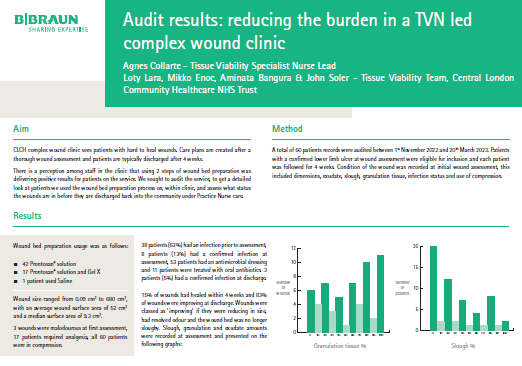
Read moreImpacts of introducing a structured wound‑cleansing pathway using Prontosan® significantly reduced infection rates by 92% - improving biofilm management and overall wound bed preparation within a large NHS Trust.
Read more
A practical guide to make wound bed preparation as easy as possible.
1. Vernon, T., Moore, K. & Collier, M. (2021) ‘Development and integration of a wound cleansing pathway into clinical practice’, British Journal of Nursing, 30(20), Tissue Viability Supplement.
2. Andriessen, A.E. & Eberlein, T. (2008) ‘Assessment of a wound cleansing solution in the treatment of problem wounds’, WOUNDS, 20(6), pp. 171–175.
3. Cooper, D.M., Bojke, C. and Ghosh, P. (2023) Cost-effectiveness of PHMB & betaine wound bed preparation compared with standard care in venous leg ulcers: A cost-utility analysis in the United Kingdom, Journal of tissue viability. https://pubmed.ncbi.nlm.nih.gov/36990897/ (Accessed: 06 July 2023).
